
Latest News:
Post written by Michelle MacQueen
We started the second day of the Colloquium with a pair of presentations under the theme Alliances, Networks, Cosmopolitanism: Haitian Transnation and the Black Pacific.
We heard first from Dr. Gage Averill. Gage is a renowned ethnomusicologist with an over-30-year history of research into Haitian popular music. He produced an award-winning book and a Grammy-nominated CD box set, as well as a string of works dealing specifically with the cultural geography and politics of music related to Haitian immigration. He has performed with rara bands, carnival ensembles and konpa groups in Haiti and in diaspora.

Photo credit: Michelle MacQueen
His presentation was titled Sonic Signification in the Haitian Transnation. He reflected on his years of doing research on Haitian music and culture. In this work, he has pursued two overarching research questions. The first question was what prompted his initial book project: How does music interact with and shape power?
The second question focused on Haitian cultural geography: How does music respond to, enact, and condition a sense of place and belonging– especially with migration and the emergence of a Haitian diaspora or transnation? He wrote in response to this question in a series of articles starting in 1993 followed by a sequence of chapters in edited volumes.
His presentation distilled the themes of this second research question, while looking at how it intersects with the former question about music and power. He explained to us how music has served as the primary signifier of the Haitian diaspora, even as this diaspora continuously changes shape. He showed us how music works at the boundaries and seeps through these boundaries to enact alliances and communities of shared interests. Music is the soundtrack to rituals that facilitate nostalgic immersion, and also help to negotiate the relationship of the community (koloni) to other US and Canadian communities, as well as to the changing circumstances on the island.

Photo credit: Marcia Ostashewski
Gage examined the strategies and tactics of musicians based in the diaspora and in Haiti. He looked at how they sought audiences, influence and prestige through performance across national boundaries, while helping to structure the basic understanding of a Haitian transnation.
He described how this research was always structured self-consciously along the lines of the “tournée” or tour. As such, Gage enacted the same cultural geography as the Haitian musicians with whom he worked. His paper was based on forty years of research on—and participation in—Haitian popular music, religious ceremonies, rara, carnival, festivals, and “folkloric” performance. After the presentation, the audience discussed the importance of locality and Gage shared some more stories from his work in Haiti, including experiences with music and social demonstrations that involved encounters with the police.
Next up was Dr. Gabriel Solis with a presentation titled Blues in the Black Pacific: Jazz, Community Music-Making, and Afro-Indigenous Alliances in Australia.
Gabriel Solis is a scholar of African American music and Indigenous musics of the Southwestern Pacific. He has done ethnographic and historical research with jazz musicians in the United States and with musicians in Australia and Papua New Guinea. Drawing on work in African American studies, anthropology, and history, he addresses the ways people engage the past, performing history and memory through music. Additionally, his work explores musicians’ and audiences’ interactions with and personalization of mass-mediated musical commodities in transnational circulation. He is the author of two books: one on Thelonious Monk and another on Monk’s collaborations with John Coltrane. He is also co-editor with Bruno Nettl of a collection of essays on improvisation cross-culturally.

Photo credit: Michelle MacQueen
Gabriel started by noting when we think of jazz and where jazz is located, we do not tend to focus on the cities of Townsville and Cairns in North Queensland, Australia. Nor do the narratives of Indigenous popular music tend to connect with jazz or boogie-woogie. And yet, Gabriel told us about a small but vibrant jazz scene among Indigenous Australians and Australian South Sea Islanders. His presentation focused on how this jazz scene offers a compelling view of global processes.
He gave us information from archival and ethnographic sources in order to describe the relationships between African American soldiers stationed in North Queensland and local Indigenous families. He noted that these relationships mark a key way of understanding the cosmopolitanism of subaltern subjects.
He demonstrated how these relationships show the politics of Black Liberation emerging beyond the Atlantic, diasporic centre. Additionally, he illustrated how the relationships show long-standing Indigenous networks of exchange continuing to produce alternative centre-periphery relations despite colonial interference.

Photo credit: Michelle MacQueen
Gabriel also described how this relationship between Indigenous peoples and African Americans through music has continued, showing us the conversation between RZA and Briggs at the Sydney Opera House.

Photo credit: Michelle MacQueen
He introduced us to the music of Georgia Lee, Seaman Dan, Wilma Reading, Johnny Nicol, Shireen Malamoo, and Syvannah Doolan, and the communities in which they grew up. He contended that looking at this music and these local connections shows how a truly global history of musical movement and connection (seen from a global southern perspective) looks different from a Eurocentric history of musical globalization.
The following pair of presentations was grouped together as Public Outreach and Education.
Dr. Alisha Lola Jones presented first. She is an assistant professor in the Department of Folklore and Ethnomusicology at Indiana University (Bloomington). She is working on a book called Flaming?: The Peculiar Theo-Politics of Fire and Desire in Black Male Gospel Performance, under contract with Oxford University Press. This book breaks ground by analyzing the role of gospel music making in constructing and renegotiating gender identity among black men. Dr. Jones’ research interests include musical masculinities, global pop music, future studies, ecomusicology, music and theology, the music industry, musics of the African diaspora and emerging research on music and future foodways (gastromusicology) in conjunction with The Institute for the Future in Silicon Valley, CA.

Photo credit: Marcia Ostashewski
Her presentation was titled “Be Grateful, We Celebrate Black History Month”: Issues in African Americans Practitioning Gospel Among European Americans.
She started her presentation by noting the passing of the gospel music icon Edwin Hawkins on January 15, 2018. After touring the world, four-time Grammy Award winner Hawkins realized that there was not sufficient information covering the history and development of Black sacred music heritage and contemporary practice. Hawkins convened the first Music & Arts Seminar in San Francisco, California in 1979– what would become one of several organizations filling in a void in gospel music cultural preservation through mobile public arts education.

Photo credit: Marcia Ostashewski
Dr. Jones explained how these organizations often spike in activity annually during the summer among African American practitioners and in February among non-African American gospel enthusiasts. Highlighting this disparity, she asked: to what extent is bias sustained through the accepted seasonality of black music education in the U.S.? More plainly, she examined what is in it for folks who share their music outside of their communities. Drawing on sentiments heard in the field (including her own work in arts leadership), Dr. Jones described sort of vulnerabilities and exploitation that occurs in these seasonal instances of black music education.
She ended her presentation with some calls to action:
- Invest time in studying black sacred music with practitioners and scholars.
- Include African American scholars and practitioners in the development and institutionalization of the research.
- Offer equitable compensation, accounting for the invisible labor of training people whose potential cultural insensitivity is anxiety inducing.
- Have an answer to the question: What is in it for them as they share their knowledge?
- Be prepared for them to decline engagement for whatever reason.
- Avoid erasing their labor by citing your sources verbally and in written form.
- And finally, despite all of our misgivings about European American’s non-committal relationship promoting formal training in black sacred music, “be grateful, we celebrate black history month.”

Photo credit: Michelle MacQueen
Next, Huib Schippers presented Encounters Festivals: Creating cultural meeting grounds for artists, communities and cultural diplomacy.
Huib Schippers is the Director of Smithsonian Folkways Recordings at the Center for Folklife and Cultural Heritage, Smithsonian Institution. He has a long and diverse history of engagement with music across various settings and cultures. With a Master’s degree in English literature and twenty years of traditional training as a professional sitar player, he proceeded with (partially overlapping) careers in performance, education, research, journalism, the record trade, arts policy, and project management. He is the author of Facing the music: Shaping music education from a global perspective and Sustainable futures for music cultures: An ecological perspective, which he co-edited with Catherine Grant.

Photo credit: Michelle MacQueen
His presentation focused on his time at the Queensland Conservatorium Research Centre at Griffith University in Brisbane, Australia between 2005 and 2013. While at this institution, he was part of a team that organized four festivals that explored cultural meetings between Australian Indigenous people and white settlers (2005); Australia and the Asia Pacific (2007); China and Australia (2010); and India and Australia (2013) respectively.
Involving students and staff from Queensland Conservatorium, artists from the cultural area and Australia, and cultural and intellectual leaders, the events aimed to fearlessly explore musical meetings and interactions–warts and all–not avoiding issues like appropriation, inherent racism and imbalances of power, but also celebrating and showcasing the benefits of various levels of cultural exchange. His presentation noted key aspects of these festivals in an effort to highlight some of the complexities and rewards of intercultural work. The discussion of this presentation focused on the role of artistic festivals and public arts events to move beyond tokenistic multiculturalism and to work harder to make meaningful intercultural events.

Photo credit: Michelle MacQueen
Dr. Ameera Nimjee led us in a public dance workshop on Kathak Dance in Hindustani Music Culture. She is a trained kathak (North Indian classical) dancer, and continues to study, perform, and teach in Canada, the United States, and India. Her publications include book chapters in Music in the American Diasporic Wedding and Dance Matters Too: Markets, Memories, Identities. A member of the Ismaili community, she was Creative Director of the Jubilee Arts Festival at Lisbon, with over 50,000 in attendance. She worked for several years in writing, programming, and curation at the Royal Ontario Museum and Aga Khan Museum, and has published a journal article on music in museums.

Photo credit: Marcia Ostashewski

Photo credit: Marcia Ostashewski
Her lecture-demonstration explored the place of kathak (North Indian classical) dance in Hindustani, or North Indian classical music culture. Kathak is known as a tradition of storytelling and dancers express poetry through the subtlety of mime. In another part of the tradition, dancers use their feet to slap and tap the floor, expressing rhythm along with live musicians. Her lecture-demonstration taught us about raag (mode) and taal (rhythm). She then showed us how dancers embody taal, contouring what it means to “improvise” the kathak approach to music-dance. The workshop ended with Ameera performing for us, and we also had the chance to hear presenter Rehanna Kheshgi sing, accompanying Ameera’s dance.
The afternoon sessions began with a session titled Political Agendas in Borderlands.
We heard first from Dr. Kaley Mason, who also gave a public lecture on Monday. His presentation today was titled Mollywood at the Borderlands: Songs of South Indian Solidarity with Latinidad.

Photo credit: Marcia Ostashewski
He described how the people of Southwestern India have experienced widespread economic emigration since the Malayalam-speaking state of Kerala was formed in 1956. After electing India’s first communist government in 1957, Kerala’s strong unions discouraged investment in industry, which prompted many workers to seek economic opportunities abroad. As a result, nearly every family has an archive of stories about migration and encounter.
These themes that have figured prominently in the region’s film industry, Mollywood. Until recently, the cinema focused on migration to the Middle East, but the 2017 film, Comrade in America, portrays a young Indian communist leader who travels to Nicaragua to join others on a journey to the Mexico-US border. Drawing on conversations with the film makers and analysis of the score, Kaley’s presentation examined how repurposing a popular communist anthem expressed solidarity with asylum seekers and refugees against the backdrop of the Trump Administration’s anti-immigration policies.
Next, we heard from Dr. Rehanna Kheshgi. She is an ethnomusicologist whose research focuses on gender, sexuality, and the body at the intersections of popular, folk, and sacred music and dance performance in India. She is currently working on a book that explores contemporary performances of gender and sexuality through Bihu, the springtime Assamese New Year’s festival. Her article “Navigating Generational Frictions Through Bihu Festival Performance in Assam, India” was published in MUSICultures, and her essay “Performing Assam in Urban Spaces: Bihu on the City Stage” was published in the edited volume Sounding Cities: Auditory Transformations in Berlin, Chicago and Kolkata by LIT Verlag.

Photo credit: Michelle MacQueen
Her presentation was titled Bodo Nritya: Mobilizing Indigenous Music and Dance in the Bengal Borderlands. She told us about the migration of people from Bangladesh into Assam, India. She described how this migration has been recast by consecutive political administrations in terms of citizenship and religious conflict, decentring struggles for control over land and natural resources.
Violent conflicts between Bodo indigenous activists and Bengali-speaking Muslims in Assam have gained international attention. However, Rehanna notes that the roots of these conflicts are often obscured. Reporting usually fails to engage with the complex history of this borderland region, notably the long history of colonialism and the various “integration” versus “isolation” approaches that have occurred over the years.

Photo credit: Michelle MacQueen
Rehanna’s lecture presented how indigenous religious practices of the Bodo community are being transformed into raw materials for supporting tribal sovereignty claims in Assam through a newly codified performance tradition called “Bodo Nritya.”
Drawing on fieldwork with indigenous choreographers, performers, and cultural activists in Bodo villages as well as in Kokrajhar (the capital of the imagined Bodo homeland “Bodoland”), Rehanna showed us how music and dance performance advances an embodied political agenda that is taking shape in the borderlands of Bengal.
Next, we had another pair of presentations under the theme Modes of Remembrance.
First was Dr. Melissa Bilal. She is Assistant Professor of Humanities and Social Sciences at the American University of Armenia. In collaboration with Lerna Ekmekcioglu, she is working on Feminism in Armenian: An Interpretive Anthology and Digital Archive, a book and digital humanities project focusing on the lives and works of twelve Ottoman-born Armenian activist women writers. Recent work includes the article Lullabies and the Memory of Pain: Armenian Women’s Remembrance of the Past in Turkey and a CD project to be released later this year called Voice Signatures: Recordings of Russian Armenian POWs in German Camps, 1916-1918. Bilal founded the Feminist Armenian Research Collective (FemArc) in 2017 while she was a visiting scholar of History at MIT.
Her presentation was titled Injuries of Reconciliation: Being an Armenian in Post-Genocide Burunkışla.
She focused on the lives of Armenians who were displaced from Burunkışla, a village in the city of Yozgat, central Turkey. She noted there is a growing scholarly literature on Armenians who survived the genocide of 1915-1922 and continued living in Turkey; yet this literature seldom includes the accounts of those who “remained” outside Istanbul in the decades following the establishment of the Republic of Turkey and eventually relocated to nearby and distant cities.
Since 2012, Melissa has been conducting interviews in Burunkışla and its diasporic “extensions” in and outside Turkey.

Photo credit: Marcia Ostashewski
Her presentation showed the formation of an embodied knowledge through everyday performances of storytelling and singing that told the unwritten history of the village. She analyzed multiple versions of narratives of escape: escape from massacres, escape from the actual physical space of the village, and escape from a condition of being–meaning an attempt to live side by side with the perpetrators and their descendants.
Drawing on the accounts and commentaries she collected during her research, this presentation critically discusses the recently fashioned definition of “forgiveness” and “reconciliation” in Turkey. She argues that it promotes a discourse celebrating a certain kind of memory at the expense of the marginalization and stigmatization of other modes of remembrance and emotions. Her presentation interpreted the transmission of songs and stories of belonging, forced migration, loss, and survival from a perspective that challenges the mainstream discourse that is shaped by an attempt to colonize affect and collective memory.
Next, we heard again from Dr. Ameera Nimjee. Her presentation was called A Lifetime of Migration: Memories of Mummyjaan.

Photo credit: Marcia Ostashewski
Her presentation explored the multiplicity of South Asian migration stories with a focus on a central figure: her grandmother, Mummyjaan, as her family called her. Mummyjaan was born into a Punjabi, Ismaili Muslim family, and moved from British India to Pakistan in 1947; Karachi to Eldoret a year later; and Nairobi to Toronto in 1973. She was among many waves of South Asians who traversed the Indian Ocean to establish new homes in parts of Asia and Africa, as the Indian subcontinent’s volatile borders were continuously redrawn through the twentieth century—a process that continues today.
She investigated her grandmother’s lifetime of politically driven migration through songs and stories, collected from her and her mother’s memories. She demonstrated how Mummyjaan’s migration story is typical in its very uniqueness, given her Punjabi cultural background, Ismaili Muslim upbringing, and adult life in East Africa.
She told us stories about Mummyjaan’s place in her religious context, her position with regards to race, and her relationships with ethnic communities. She connected these stories to music, by showing how they were mirrored in Mummyjaan’s musical life, which was always present in her many homes throughout her lifetime.
The final paired presentations of the day were under the theme Musical Life Stories.
First we heard from Dr. Svanibor Pettan, who gave a public film screening on Monday. His presentation was called Songs and Stories of Minority Musicians in Their Musical Encounters.

Photo credit: Marcia Ostashewski
In this presentation, Svanibor argued against the common perception of minorities as unified collectives engaged in institutionalized performance of respective music and dance traditions in stylized costumes. Instead, he used biography to point to the internal dynamics, marked by individual, sometimes confrontational experiences of migration and encounter. He showed us three life stories that featured Slovenian musical personalities with the Macedonian, Sinhalese, and Romani roots, active in different musical genres: Ljuben Dimkaroski (who was featured in the film screened at our Centre on Monday night), Lasanthi Mamnaranjanie Kallinga Dona, and Imer Traja Brizani.

Photo credit: Marcia Ostashewski
His presentation focused on the following questions: How do they interact within their respective minority circles and with the majority population in a less than three decades old nation-state? How these encounters affect their lives and professional careers? Nevertheless, what are the modalities of their mutual contacts? He revealed the emotional response of individuals caught in the majority-minority discourse within the broader theoretical framework of music and minority studies.
Next we heard from Terada Yoshitaka, who gave two public film screenings on Tuesday. His presentation was titled Performing Migrant Experiences in Japan: Ahn Sungmin and Zainichi Korean Pansori.

Photo credit: Michelle MacQueen
Zainichi Koreans refer to those Koreans who migrated to Japan during its colonization of the Korean peninsula (1910-45). He described their presence in Japan as an eloquent testimony to the history of Japanese colonialism and to the power struggle in ensuing years between the USSR and the USA (resulting in the division of the Korean peninsula). He noted that the lived experiences and identities of Zainichi Koreans have been severely affected by the unstable and often contentious relationship between Republic of Korea (more commonly, South Korea), Democratic People’ Republic of Korea (North Korea), and Japan.

Photo credit: Marcia Ostashewski
Throughout the presentation, he examined the history of Korean migrants in Japan through the activities of one contemporary artist: Ahn Sungmin. He described her personal and artistic trajectory as reflective of the hardship and hope of many Zainichi Koreans. Ahn Sungmin is a third generation Zainichi Korean from Osaka, whose mastery over the art of pansori (traditional narrative genre) is considered extraordinary by many in her community. He described her innovative performance style and introduced a newly composed pansori based on the theme of forced migration. He reflected on how this new piece of music speaks to Zainichi Koreans identities and histories and works to reclaim the past. It keeps the memory of the history alive (however painful), and reasserts Zainichi Koreans existence in an art form. Ahn Sungmin was featured in the film Crossing over the Arirang Pass: Zainichi Korean Music, screened at the McConnell Public Library on Tuesday.

Photo credit: Michelle MacQueen
We ended the night by hearing again from Dr. Gage Averill, though this time in a public lecture called Echoes of “Haïti Cherie” in the “koloni.”

Photo credit: Rachael Murphy
Gage explained to us that in the 1930s, an expatriate Haitian penned the nostalgic méringue “Haïti Cherie”– a classic of the Haitian patriotic canon and a foundational musical commentary on emigration. He started the presentaiton by getting us all to sing the song together.
Gage explained how Haiti has had many waves of emigration, forming the dyaspò (diaspora) in North America (1950s-present).
This transnational status of the Haitian population has been captured in thousands of songs. In these songs, there are stories that celebrate the “koloni-s” (“colonies,” Haitian communities abroad). There are also stories that bemoan the hardships of emigration and the treatment of immigrants and refugees. And there are stories that advocate for rights, or boast of newfound success. Because of all of these different (and at times contradictory) stories of Haitian emigration/immigration, they can’t be distilled into one theme.

Photo credit: Rachael Murphy
He played us examples from Skah shah, Farah Juste, Manno Charlemagne, and the Fugees. We also heard “Respect” by Tabou Combo as well as “Libète” by Magnum band. Gage explained how these songs and stories (among many others) can be read as an adaptation to a transitional identity: as these songs circulate, they come to define new boundaries and to maintain that identity; and in their diverse stories of migratory experience, they provide a narrative supporting migrants in their ongoing negotiation over status, visibility / voice, rights and identity. Perhaps more plainly, Gage described these songs as a sonic fence around people: they are a way to realize many commonalities, and to negotiate politics that transcend the nation state.
Post written by Michelle MacQueen
Today marked the first official day of the 26th International Council for Traditional Music Colloquium. We spent the day at Membertou Heritage Park. Our discussions started with acknowledging the land on which our Colloquium took place: Mi’kma’ki — the unceded territory of the Mi’kmaq. We talked about the history of Membertou, and also more broadly about the history between Canada and Indigenous peoples, noting that there is significant work still to done.
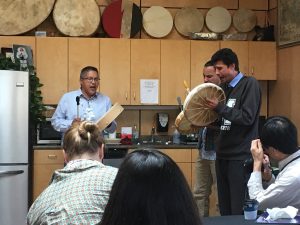
Photo credit: Rachael Murphy
We were honoured to have started our day by listening to the singing and drumming of Graham Marshall, David Meuse, and Bill Meuse. We thank them for sharing these songs and stories with us.
We were welcomed by Vice President Academic and Provost at Cape Breton University, Richard MacKinnon.
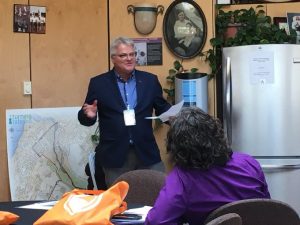
Photo credit: Rachael Murphy
Svanibor Pettan also welcomed us on behalf of the ICTM and gave us an overview of the organization’s mandates.
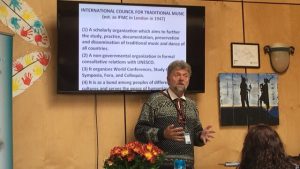
Photo credit: Rachael Murphy
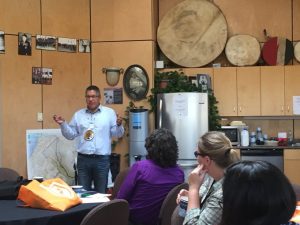
Photo credit: Rachael Murphy
We then heard from Graham Marshall, who gave a presentation called Wula Na Kinu: This Is Who We Are. Graham was born and grew up in Membertou First Nation. He speaks and sings Mi’kmaq, and is a founding member of the Sons of Membertou. The group’s first album (1995) was nominated at the East Coast Music Awards, and they performed at the Halifax G7 that same year. He recently established another drum group, The Kun’tewiktuk Singers. Marshall worked with Mi’kmaq Family and Children’s Services for more than ten years and developed a mentorship program, in which older youth are paired with younger children to provide support through traditional practices. He is dedicated to continuing Mi’kmaq culture through the practice of singing, drumming, and other traditional knowledge, and to passing these traditions and knowledge to the next generation.
As a Membertou Council Member, Graham is active in the development and actualization of Indigenous policies and governance, and in implementing the recommendations of the Truth and Reconciliation Commission. He serves on the Council’s Executive, focusing on community and cultural development, including Indigenous tourism. Graham told us about migration and encounter particularly with stories from his own life and experience. He also introduced us to the Kun’tewiktuk play that was created through Membertou’s collaboration in an earlier research-creation project phase with Marcia Ostashewski and the Centre for Sound Communities research team. Kun’tewiktuk tells the story of the forced relocation of the Kings Road Reserve community to its current Membertou location.
Next, we had our first keynote presentation from Tina K. Ramnarine. She is Professor of music at the Royal Holloway University of London and a musician, anthropologist and global cultural explorer. Her research focuses on music in global histories, cultural heritages and identity politics, as well as arts responses to contemporary global challenges. She has carried out extensive research across the Nordic countries, especially on Finnish and Saami music. She has worked on Caribbean music, labour histories in the Indian Diaspora, and intercultural gamelan projects in Bali. Her latest publications include the edited volumes Global Perspectives on Orchestras: Collective Creativity and Social Agency, We Mark Your Memory: Writings from the Descendants of Indenture, and Dance, Music and and Cultures of Decolonisation in the Indian Diaspora. She has broad interests in transnationalism, decolonizing scholarship and postcolonial studies.
Her talk was titled Reclaiming Indigenous Cultural Heritage in an Island of Multiple Diasporas. Looking at the island of Trinidad, she notes that until until recently, Trinidad’s Indigenous communities were mostly invisible. In the last couple of decades they have become increasingly politically active and hence visible.
Her presentation discussed reclamations of Indigenous cultural heritage in an island of multiple diasporas. Looking to music, she showed examples of parang and to the changing politics around this genre. Her discussion draws on literary insights from Wilson Harris’s The Ghost of Memory, particularly the questions he poses in relation to new histories of Indigeneity: “What is spirit? What is the New World? What is art? What is truth?”
Through her discussion of parang and sites like Pitch Lake, Tina examined how heritage sites and cultural heritage practices are dimensions of the recuperative imaginaries of the arts, overlapping with diasporic cultural histories of African enslavement and Asian indenture. She suggests that in this context, Trinidad becomes a laboratory for examining the dynamics of migration and encounter between ‘Indigenous’ and ‘diasporic’, as well as reclamations of cultural heritage across both identity categories.

Photo credit: Marcia Ostashewski
Dr. Alex E. Chávez gave a public lecture and demonstration about Sonic Bridges: Home, Intimacy, and the Borderlands. He is the Nancy O’Neill Assistant Professor of Anthropology at the University of Notre Dame, where he is also a faculty fellow of the Institute for Latino Studies. Dr. Chávez’s research and teaching explore Latina/o/x expressive culture in everyday life as it manifests through sound, language, and performance. He has published in various academic journals, contributed to numerous prominent volumes, and his writing has been featured in public venues such as the Huffington Post and Revista Contratiempo. His book Sounds of Crossing: Music, Migration, and the Aural Poetics of Huapango Arribeño has won many awards, including the Alan Merriam Prize from the Society for Ethnomusicology. He has consistently crossed the boundary between performer and ethnographer in the realms of both academic research and publicly engaged work as an artist and producer.
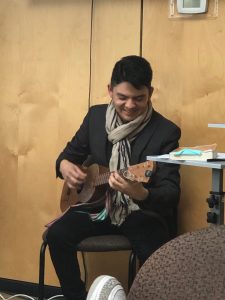
Photo credit: Marcia Ostashewski
An accomplished musician and multi-instrumentalist, Chávez has recorded and toured with his own music projects, composed documentary scores (most recently Emmy Award-winning El Despertar), and collaborated with Grammy Award-winning artists. In 2016, he produced the Smithsonian Folkways album Serrano de Corazón.
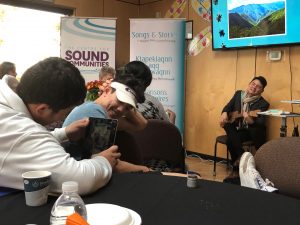
Photo credit: Marcia Ostashewski
Alex introduced us to huapango arribeño, a musical genre originating from north-central Mexico. A musician himself, Chávez has placed sound at the centre of his artistic practice, scholarship, and publicly engaged work. In this presentation, he discussed how the musico-poetic design and performance of huapango arribeño produce shared sentiments of intimacy, conviviality, and companionship. He also shared his own stories about how he has brought these insights in both his academic and creative work as a means of hearing across multiple types of borders.
Alex ended his presentation with a performance of one of his own songs.
We ended the evening with a public event by Dr. Afua Cooper. She is a senior academic trained in the history of Black people in Canada, and the African Diaspora. Her book on Canadian slavery broke new ground in the study of Canadian and Atlantic slavery and it was nominated for a Governor-General’s award, and named by the CBC as one of the best books published in Canada. A recognized poet, spoken word artist, and wordsmaestra, Afua helped found the Dub Poetry movement in Canada and organized five international Dub Poetry festivals in Canada, in addition to publishing five books of poetry and recording two poetry CDs. In recognition of her poetry she was installed in 2018 as Halifax Region’s Poet Laureate. An academic leader, Afua founded the Black Canadian Studies Association, the Dalhousie Black Faculty and Staff Caucus, and she established the Black and African Diaspora Studies Minor at Dalhousie. Her awards and achievements include: the Ontario Black History Society Daniel G. Hill Community Service Award (2019); Canadian Trailblazers Award, Historica Canada Recognition (2017); a SSHRC Scholar of Honour feature (2017); Nova Scotia Human Rights Award (2015). The impulse behind the work of this multi-disciplinary scholar/artist is democratic. She aims to bridge the gap between academe and the world at large.
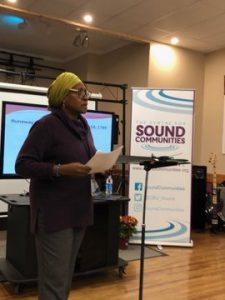
Photo credit: Marcia Ostashewski
Her presentation was entitled Fugitive Verses/Sonic Stories: Slavery, the Middle Passage, and the Soundscapes of Black People’s Freedom Quest.
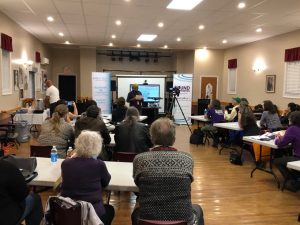
Photo credit: Marcia Ostashewski
Through a series of poetic performances, she drew on history, poetry, memory, literary archaeology, slave narratives, petitions, advertisements for runaway slave, and sale of slaves, Negro Spirituals, and dub poetry–all to tell a sonic story of the awfulness, the brilliance, the pain and anguish, and the resilience that are part and parcel of Black people’s 500-year migratory journey within Canada and the African Diaspora. From Cape Breton in the North Atlantic to the Niagara Peninsula in the south, to Victoria in the West, “Fugitive Verses” sings the Black Atlantic. Afua opened with a moving performance of The Child is Alive.
She told stories about historic figures like John Ware and Richard Pierpoint. We heard about migrations across the Atlantic in 15 Ships and about the Caribbean in Ra Ra. She also shared some very local stories in the poem Shots Rang Out On My Street Today, in conversation with the recently released Halifax Street Checks Report.
Afterwards, the audience discussed how poetry and performance as means of mobilizing public-facing scholarship, which Afua noted was one of the major successes of the recent project blackhalifax.com.
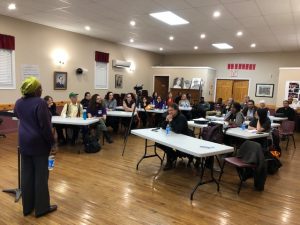
Photo credit: Marcia Ostashewski
Special Events:

COVERED IN SALTWIRE MARCH 11, 2024! "Tea and conversation with elders at Cape Breton University":

ARCHIVE OF NEWSFLASH ANNOUNCEMENTS:
TransAtlantic Pilgrimage - Celebrating African Heritage 2024
 Watch this space for more details to come! This exciting festival includes film showcases plus dance & music workshops, to be held in multiple locations around Unama'ki: Sydney, Chéticamp, Glace Bay, Membertou Heritage Park, on campus and off — and every event is FREE and OPEN TO THE PUBLIC, so come and join in! We are honoured to feature dub poet/performer/historian Dr. Afua Cooper and Afropop/jazz/rhumba musician Mark Lenini Parselelo in this colourful celebration. For more information, or to register for the Teacher Professional Development Workshops, please e-mail sound_communities@cbu.ca or call 902-563-1696.
More details to be found under Events.


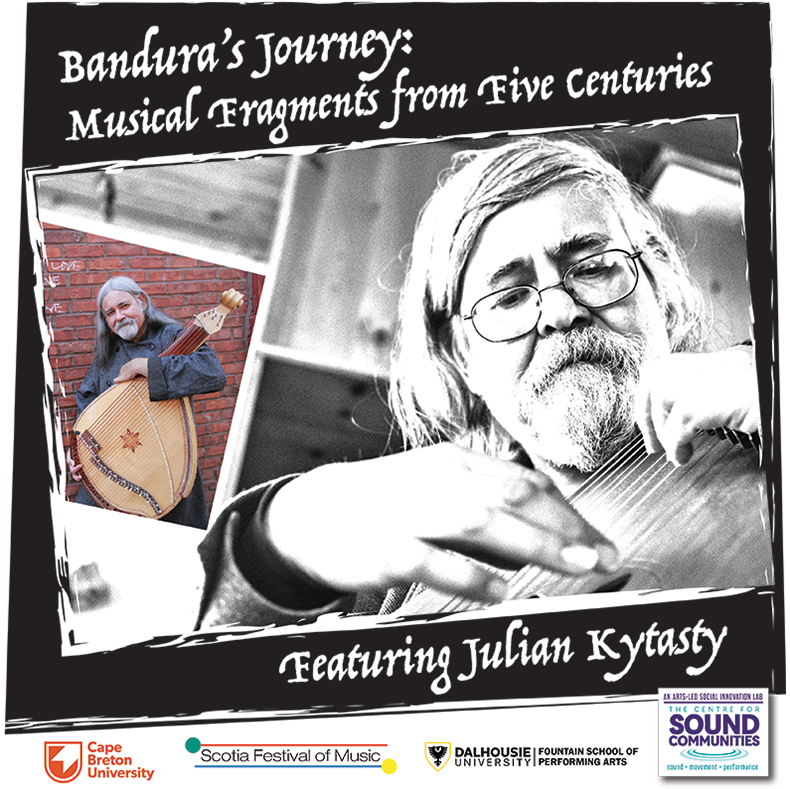
March 5th, 2023 | Halifax, NS | Julian Kytasty


1) ICTM DIALOGUES Digital Publication ‘DIALOGUES: Towards Decolonizing Music and Dance Studies’ https://ictmdialogues.org/
2) International Council for Traditional Music (ICTM) http://ictmusic.org
3) The Centre for Sound Communities (CSC) https://soundcommunities.org
4) Canadian Society for Traditional Music (CSTM) https://cstm-sctm.ca
* * * * * * *

* * * * * * *

Bandura Master, Kobzar & Composer of Ukrainian Descent:
JULIAN KYTASTY IN CONCERT ~ two dates!


* * * * * * *


 ICTM PRIZE-WINNERS! Congratulations to our esteemed research collaborators & co-authors* at Membertou First Nation on being awarded the 2021 ICTM Article Prize ~ announced last Saturday at the General Assembly of the International Council for Traditional Music.

The first session of this course took place Thursday, July 22 ~ inspiring and uplifting. If you’d like to join in the second / final session taking place next Thursday, July 29 at 6:30 p.m. Atlantic Time, register here. We hope you’ll join us!
The Centre for Sound Communities congratulates Dr. Sheila Christie on her recent appointment as Chair of the Department of Literature, Folklore and The Arts, and we also thank her for her many contributions to the CSC as she leaves the post of Associate Director. Dr. Christie has exerted truly magnanimous effort in support of faculty and student researchers. She operates on the basis of scholarship and a teaching practice based on care; her thoughtful, dedicated service to the CSC, CBU and wider communities is greatly appreciated by many, as is her commitment and drive, and her impressive ability to get things done. We wish her well in her next chapter!

Join the Summer Celebration! Zoom link is here!

Welcome, Dr. Shauna MacDonald, and thank you, Dr. Sheila Christie! Watch this space for word on a special virtual event coming July 15 to which all are invited!

Registration now open for the Summer Institute 2021 Cantoring Course!
Both sessions of this course take place at 6:30 p.m. Atlantic time.
Session 1 - July 22: Register here
Session 2 - July 29: Register here

Check out the CSC YouTube Channel here to watch a recording of the panel from our June 10 event: Disrupting the Legacies of Colonialism and White Supremacy in Music Schools ~ with thanks to all the participants and registrants in this stellar workshop, as well as to Dr. Dylan Robinson and Dr. Jeremy Strachan for organizing this inaugural DIALOGUES event. [In the coming weeks, we will re-post the video with transcribed text in the hopes of making this ~ and future DIALOGUES events ~ as accessible as possible. Be sure to visit our FB page for news of upcoming events!]

*Coming this Fall 2021!*
Stay tuned for a series of Anti-Racist Pedagogies workshops happening this fall, which will feature a stellar lineup of international scholars and practitioners! For details and registration links, keep checking in on the CSC Facebook page for updates.

New DIALOGUES project workshop to be presented June 10, 2021! Find out more here!
On Friday, May 14, 2021, the Canadian Studies Center, Henry M. Jackson School of International Studies at the University of Washington, Seattle presented ‘Singing Sunjata’s Story in Cape Breton, Nova Scotia: A Mali-Canada Musical Collaboration’. The event featured CSC Director Dr. Marcia Ostashewski and research colleague, culture-bearer and internationally renowned musician Lassana Diabaté in conversation and concert. A link to the event video will be released later in May, but for further information about the project, please refer to the Projects menu selection on this website, or find out more on the Bala website: https://balafondiabate.ca/

